
Crawler cranes, also known as crawler-mounted cranes, are essential lifting machines in modern construction and heavy industry. Equipped with a tracked undercarriage system, they offer superior stability, strong lifting capacity, and excellent off-road performance. From early mechanical designs to today’s intelligent heavy-duty lifting equipment, crawler crane technology has evolved significantly over the past century.
This article explores the history, technological advancements, and future trends of crawler crane development.
What Is a Crawler Crane?
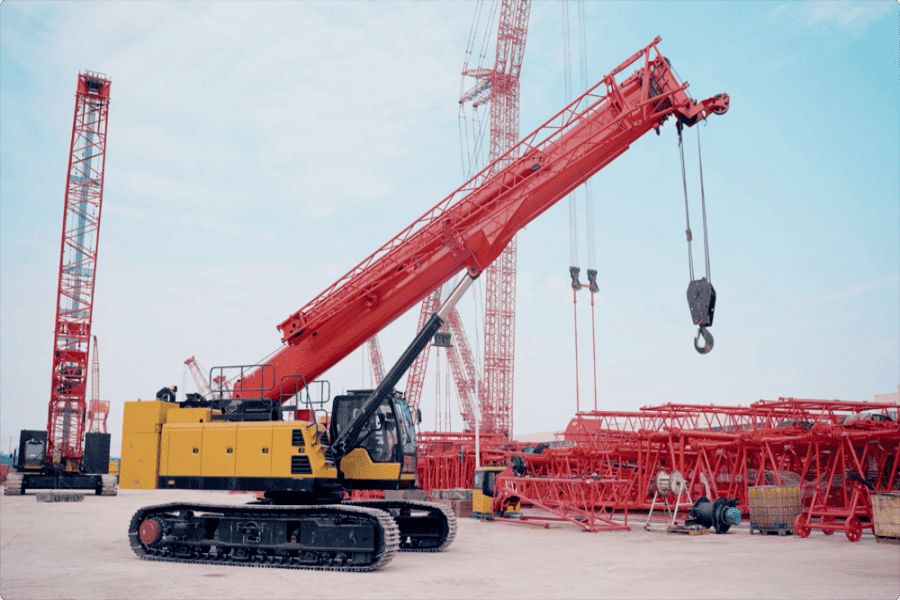
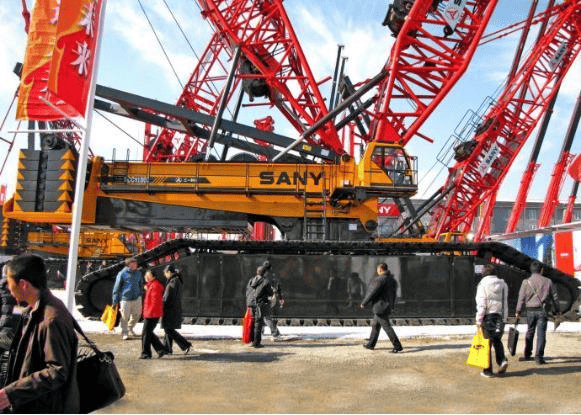
A crawler crane is a type of lifting equipment that uses crawler tracks instead of wheels for movement and support. The tracked chassis allows the crane to operate on uneven terrain, soft ground, and complex job sites with greater stability and safety.
Key Characteristics:
- Tracked undercarriage for superior mobility
- High lifting capacity (from tens to thousands of tons)
- Excellent stability on rough terrain
- Suitable for long-term heavy-duty operations
Crawler cranes are widely used in:
- Building construction
- Bridge engineering
- Mining operations
- Port terminals
- Road and infrastructure projects
- Hydropower and energy construction
Early Development: The Beginning of Crawler Crane Technology
The origins of crawler crane technology can be traced back to the early 20th century. Early models were initially developed for ship unloading and railway construction. However, early wheel-based or hybrid crawler systems were limited in performance and lifting capacity.
By the 1930s, European manufacturers introduced steel-track crawler cranes, which significantly improved load-bearing capacity and off-road mobility. These cranes quickly gained popularity in heavy industrial sectors due to their strength and reliability.
During World War II, crawler cranes became part of military logistics and engineering operations. They were widely used for material transport, infrastructure building, and field construction.
Post-War Expansion and Industrial Growth
After the war, global industrialization accelerated. The demand for infrastructure, ports, bridges, and large industrial plants led to rapid improvements in crane technology.
Key developments during this period included:
- Stronger steel structures
- Improved hydraulic systems
- Enhanced lifting mechanisms
- Increased boom length and lifting capacity
Crawler cranes became indispensable for large-scale engineering projects due to their powerful lifting performance and site adaptability.
Technological Innovation in the 1990s: Modular and Multi-Function Design
In the 1990s, European and American manufacturers introduced modular crawler crane systems. These cranes featured:
- Interchangeable boom sections
- Adjustable working radius
- Flexible lifting configurations
This modular design allowed contractors to adapt the crane to different working conditions, significantly improving efficiency and reducing operational costs.
21st Century: Intelligent and Electronic Control Systems
With the introduction of electronic control systems in the early 2000s, crawler cranes entered a new era of intelligent operation.
Modern crawler cranes now feature:
- Electronic control systems
- Real-time load monitoring
- Automatic fault diagnosis
- High-precision positioning systems
- Camera monitoring for enhanced safety
Touchscreen interfaces and advanced hydraulic-electronic integration make operation more intuitive and safer. Automation improves work efficiency while reducing human error.
Core Structure of Modern Crawler Cranes
A modern crawler crane typically consists of:
- Engine System – Provides primary power
- Hydraulic System – Controls lifting and rotation
- Travel Mechanism – Includes tracks, sprockets, rollers, and tension systems
- Rotary Platform – Enables 360-degree rotation
- Boom and Lifting Mechanism – Responsible for load handling
- Operator Cabin – Equipped with advanced monitoring systems
Main Advantages of Crawler Cranes
1. Flexible Mobility with Tracked Undercarriage
The crawler chassis allows movement across uneven, muddy, or damaged surfaces. Compared with wheeled cranes, crawler cranes reduce the risk of slipping and improve on-site safety.
2. Powerful Lifting Capacity
Modern crawler cranes can lift hundreds or even thousands of tons. Their long boom structure and hydraulic lifting systems provide exceptional lifting performance.
3. Strong Adaptability
Crawler cranes perform well in challenging environments such as:
- Mining sites
- Bridge construction
- Hydropower projects
- Large-scale infrastructure developments
They are often the preferred solution for heavy-duty and long-duration projects.
4. User-Friendly Operation
Advanced electronic systems, interactive touchscreens, and intelligent control modules simplify crane operation. Automated monitoring reduces accidents and improves productivity.
The Future of Crawler Crane Technology
Today, leading global construction machinery manufacturers continue to innovate in:
- Intelligent control systems
- Energy-efficient hydraulic systems
- Lightweight high-strength materials
- Modular boom configurations
- Green and environmentally friendly technologies
Future crawler cranes are expected to become:
- More automated
- More energy-efficient
- More adaptable to extreme working conditions
- Easier to transport and assemble
With advancements in smart manufacturing and digital technology, crawler cranes will continue to play a vital role in infrastructure development, renewable energy projects, and global construction markets.
Conclusion
From early mechanical lifting machines to today’s intelligent heavy-duty equipment, the development journey of crawler crane technology reflects the progress of global engineering innovation.
As infrastructure projects become larger and more complex, crawler cranes will remain a key solution for safe, efficient, and high-capacity lifting operations worldwide.
FAQ
A crawler crane is a heavy-duty crane mounted on tracks, offering superior stability, off-road mobility, and high lifting capacity for construction and industrial projects.
They are widely used in building construction, bridge engineering, mining, port terminals, road infrastructure, and hydropower projects.
Crawler cranes move on tracks instead of wheels, providing better stability on uneven terrain, while tower cranes offer height advantage but are fixed in one location.
They provide flexible mobility, powerful lifting capacity, strong adaptability to harsh environments, and user-friendly operation with intelligent electronic systems.
Future developments focus on automation, energy efficiency, lightweight materials, modular boom designs, and environmentally friendly technologies.