
When buying a used rotary drilling rig for cased piling, contractors need to evaluate more than rotary torque and maximum drilling depth. The crowd system determines how the rotary drive moves along the mast and applies downward or upward force. Its configuration affects casing handling, drilling cycles and equipment suitability.
Cylinder crowd and winch crowd systems can both support cased piling when correctly configured. The purchasing decision should consider usable stroke, rated push and pull forces, casing requirements and the condition of the actual machine.
Understanding the Crowd System
The crowd system moves the rotary carriage along the mast. During Kelly drilling, it applies feed force through the rotary drive and an appropriately engaged Kelly bar. With compatible casing equipment, it also supports casing installation and extraction.
The crowd winch and main winch perform different functions. The main winch principally handles the Kelly bar and drilling tool, while the crowd system controls carriage movement. Their ratings should be evaluated separately.
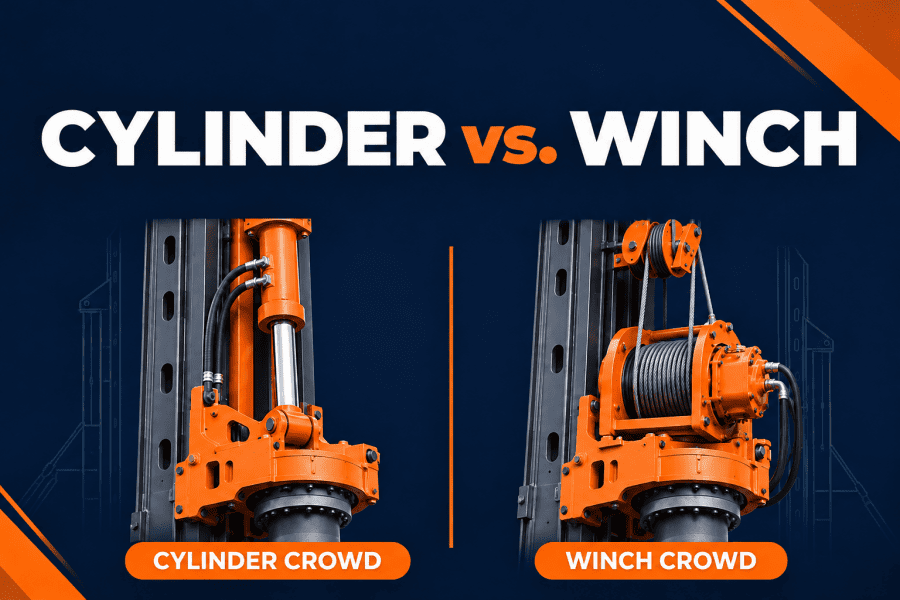
Cylinder Crowd: Direct Hydraulic Actuation
A cylinder crowd system uses a hydraulic cylinder to move the rotary carriage. Its available travel depends on the cylinder stroke and mounting arrangement.
For projects where casing handling fits within this travel, cylinder crowd can provide a suitable configuration. Buyers should verify both downward crowd force and upward retraction force: these values may differ.
Manufacturer specifications illustrate this distinction. For example, the Soilmec SR-45 lists separate cylinder-system pull-up and pull-down ratings, alongside a different set of winch-system ratings. Such figures apply to the specified configuration rather than every machine in the same size class. Soilmec SR-45 technical data
Winch Crowd: Longer Carriage Travel
A winch crowd system uses a hydraulic winch, wire ropes and sheaves to move the rotary carriage. Depending on the mast design, it can provide substantially longer travel than a cylinder arrangement.
This longer stroke can benefit projects involving long casing sections by reducing interruptions associated with limited carriage travel. SANY identifies long-stroke winch crowd as a feature for casing construction in formations such as gravel and backfill. SANY rotary drilling rig features
However, longer stroke does not automatically mean greater extraction capacity. Buyers must compare the published forces and operating limits of each candidate rig.
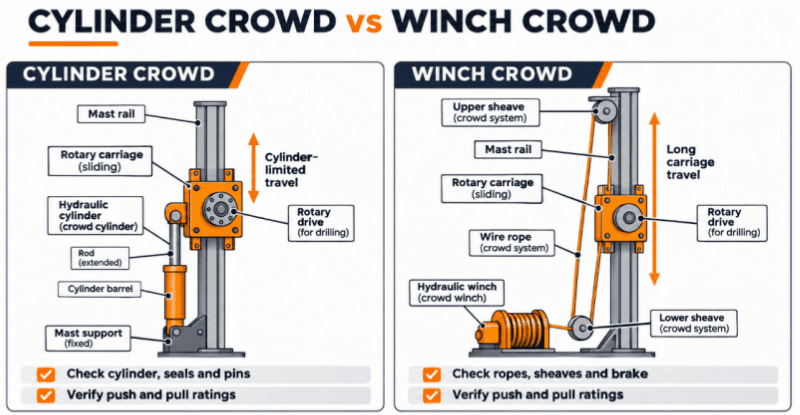
| Selection factor | Cylinder crowd | Winch crowd |
|---|---|---|
| Carriage travel | Limited by cylinder arrangement | Often longer, depending on mast configuration |
| Force ratings | Verify push and pull separately | Verify effective carriage forces |
| Inspection focus | Cylinder, seals, pins and mountings | Ropes, sheaves, drum, tensioning and brake |
Four Checks for Cased Piling Projects
1. Match stroke to the casing sequence.
Compare usable carriage travel with casing section length, adapter dimensions and connection clearance. Crowd stroke is different from maximum drilling depth, which also depends on the Kelly bar and tooling.
2. Evaluate installation and extraction separately.
A rig may advance casing successfully yet struggle during withdrawal. Assess casing weight, embedded length, ground resistance and available retraction force. Rotary torque alone cannot establish extraction capability.
3. Confirm the complete casing arrangement.
Check the casing drive adapter, connection dimensions, casing joints and manufacturer-approved operating configuration. Where an oscillator or rotator is required, verify its mechanical and hydraulic compatibility with the rig.
4. Verify any combined-pull claims.
Do not simply add main-winch and crowd-system ratings. Combined extraction requires an approved load path and control arrangement. Liebherr’s Crowd Booster, for example, uses dedicated equipment and synchronized winch operation to transfer additional pull to the casing driver. Liebherr Crowd Booster
As a procurement example, a contractor using short temporary casing may find that a suitable cylinder-crowd machine meets the planned sequence. A project using longer casing sections may justify prioritizing winch crowd. These are starting points for evaluation; neither choice should be finalized without checking the actual configuration against project requirements.
Inspecting the Crowd System on a Used Rig
For a used cylinder-crowd rig, examine the piston rod, seals, mounting pins and attachment points. Investigate leakage, scoring, unusual movement or evidence of structural repairs.
For a used winch-crowd rig, inspect rope condition, sheave grooves, rope anchorage, drum spooling and tensioning components. Review brake performance and replacement records against manufacturer requirements.
A qualified technician should assess operation through the permitted working range and conduct appropriate performance checks. Record the test conditions and results. Smooth unloaded movement alone does not demonstrate that the system can deliver its rated force.
Discuss Your Casing Requirements with Maxtop
Maxtop supplies used rotary drilling rigs for international buyers. When requesting a quotation, provide the pile diameter, drilling depth, ground conditions, casing diameter, section length and intended installation method.
Ask for confirmation of the offered machine’s crowd type, usable stroke, force ratings and included casing accessories. This creates a clearer basis for comparing equipment and identifying a configuration suited to your project
Frequently Asked Questions
Both systems can support cased piling when correctly configured. Cylinder crowd may suit projects where the casing sequence fits its available travel. Winch crowd often provides longer carriage travel. Selection should also consider push force, retraction force, casing dimensions and ground conditions.
No. Longer travel does not automatically mean greater pulling capacity. Compare the manufacturer’s rated retraction forces for the exact configurations, then assess the condition of the used equipment.
No. Crowd stroke describes rotary carriage travel along the mast. Maximum Kelly drilling depth also depends on the Kelly bar configuration, drilling tool and available working clearance.
Yes, where the manufacturer provides a compatible arrangement. Buyers should verify the mounting interface, hydraulic requirements, controls and operating clearance. Cylinder crowd alone does not rule out oscillator-assisted casing work. Manufacturer configuration example
Only where the rig has a manufacturer-approved combined-pull arrangement. Main-winch and crowd-system ratings should not simply be added together. Dedicated equipment and coordinated controls may be required. Example of an approved combined-pull system
Provide the pile diameter, drilling depth, ground conditions, casing diameter, casing section length and planned installation method. Request confirmation of the offered rig’s crowd type, usable stroke, push and pull ratings, and included casing accessories.