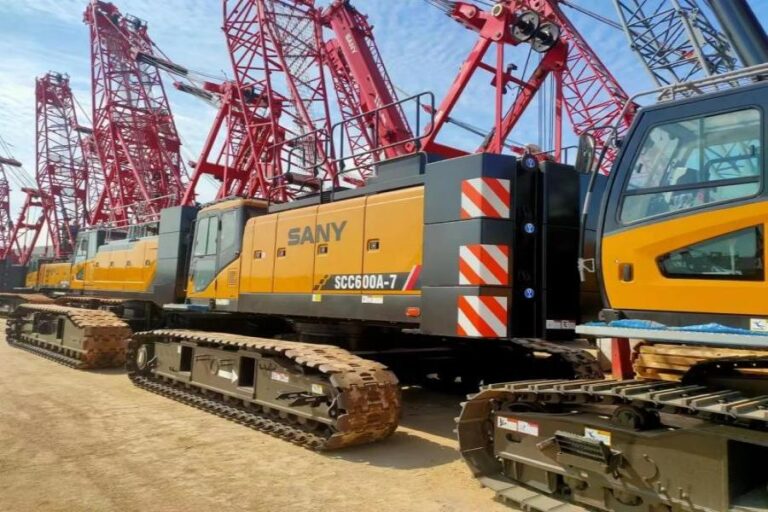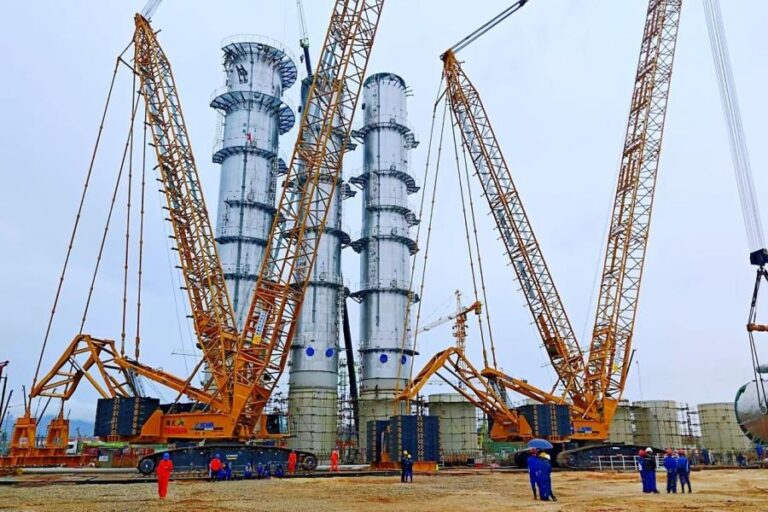

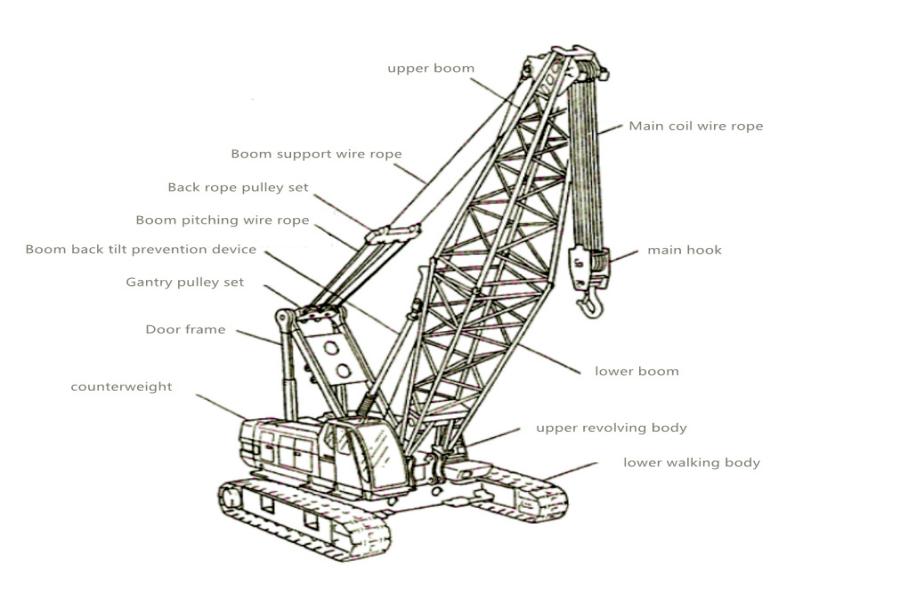
A crawler crane, also known as a crawler-type crane, is a full-rotation lifting machine mounted on a tracked undercarriage. It is widely used in heavy construction, bridge building, wind power installation, petrochemical projects, and infrastructure development.
What makes a crawler crane unique is its strong lifting capacity, ability to operate on soft ground, and capability to travel with load under certain conditions. These advantages come from its carefully engineered structural components.
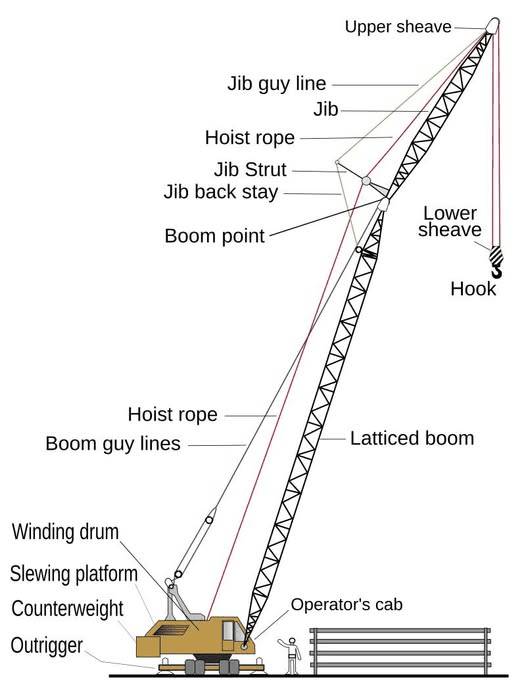
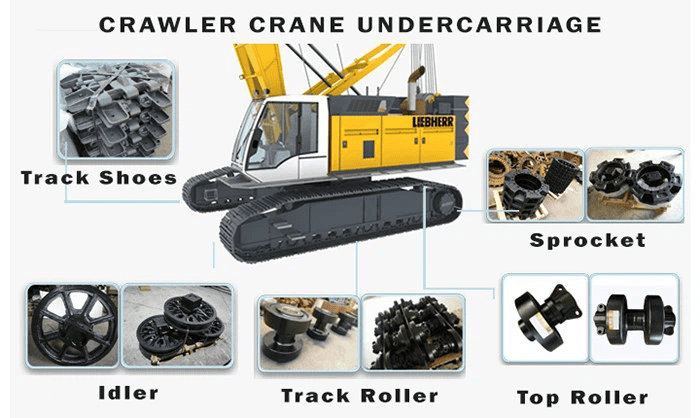
Crawler Undercarriage (Lower Structure)
The crawler undercarriage, also called the lower structure, forms the foundation of the entire crane.
Main Parts of the Undercarriage:
- Track frames
- Track shoes (crawler plates)
- Drive sprockets
- Idlers
- Track rollers
- Carrier rollers
- Travel motors
Function
The undercarriage provides:
- Load-bearing support
- Machine stability
- Mobility on uneven terrain
Unlike wheeled cranes, crawler cranes distribute weight over a large surface area. This results in low ground pressure, allowing the crane to operate on muddy, sandy, or soft construction sites without sinking.
The tracked system also allows:
- Small turning radius
- Travel with load (under controlled conditions)
- Better traction on rough terrain
This is why crawler cranes are commonly used in mining, foundation works, and undeveloped job sites.
Slewing Mechanism (Swing System)
The slewing mechanism connects the lower structure to the upper rotating platform.
Key Components:
- Slewing ring bearing
- Slewing motor
- Gear system
- Slewing brake
Function
This system enables the crane to rotate 360 degrees continuously, making it a full-rotation crane.
The slewing ring bearing supports the entire upper structure, including:
- Boom
- Engine
- Winches
- Counterweights
- Operator cabin
A properly maintained slewing system ensures:
- Smooth rotation
- Precise positioning
- Stable lifting performance
Any wear in the slewing bearing can affect accuracy and safety, making it a critical inspection point.
Upper Structure (Superstructure / Turntable)
The upper structure sits on top of the slewing mechanism and contains the main operational components of the crane.
Installed Components:
- Engine
- Hydraulic system
- Main winch (hoisting mechanism)
- Luffing mechanism
- Operator cabin
- Control systems
Function
The upper structure houses all systems responsible for:
- Lifting
- Boom angle adjustment
- Power generation
- Machine control
Because the entire superstructure rotates, operators can lift and place loads in any direction without moving the undercarriage.
Boom System (Lifting Structure)
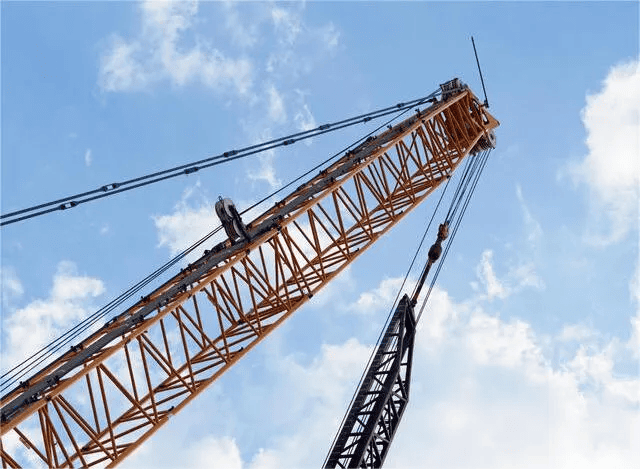
The boom system is the primary lifting structure of the crawler crane.
Main Elements:
- Main boom
- Jib (fixed or luffing)
- Gantry / A-frame (mast)
- Hook block
Structural Design
Crawler crane booms typically use a lattice (truss) structure instead of telescopic sections. This design provides:
- High strength-to-weight ratio
- Reduced wind resistance
- Excellent stability under heavy loads
The boom length can be increased or reduced by adding or removing sections, making it adaptable to different lifting heights and jobsite requirements.
Types of Boom Configurations:
- Standard main boom
- Fixed jib extension
- Luffing jib
- Tower attachment
Each configuration serves different applications, such as wind turbine installation or high-rise construction.
Hoisting Mechanism (Winch System)
The hoisting system is responsible for lifting and lowering loads.
Includes:
- Main winch
- Auxiliary winch
- Wire rope
- Hook block
Function
The main winch handles heavy lifting tasks, while the auxiliary winch is often used for lighter operations or secondary hooks.
Key performance factors include:
- Line speed
- Line pull capacity
- Braking reliability
A high-performance winch ensures smooth, controlled lifting, which is essential for safety and efficiency.
Luffing Mechanism (Boom Angle Control)
The luffing system controls the boom angle.
Components:
- Luffing winch
- Wire ropes
- Sheaves
- Boom backstops
Function
By adjusting the boom angle, operators can:
- Control lifting radius
- Modify lifting capacity
- Position loads precisely
The lifting capacity of a crawler crane changes depending on boom length and angle, so accurate luffing control is critical.
Power and Transmission System
Most crawler cranes are powered by a diesel engine.
Key Components:
- Diesel engine
- Hydraulic pumps
- Hydraulic motors
- Cooling system
Function
The engine generates power, which is transferred through hydraulic systems to operate:
- Winches
- Travel motors
- Slewing motors
- Boom mechanisms
Modern crawler cranes use advanced hydraulic systems to improve:
- Fuel efficiency
- Load control precision
- Operational smoothness
Efficient power transmission directly impacts productivity and operating cost.
Counterweight System
Counterweights are located at the rear of the upper structure.
Function
They balance the overturning moment created by lifting heavy loads. Without proper counterweight:
- The crane could tip forward
- Lifting capacity would decrease
- Safety risks would increase
Counterweights are typically modular, allowing adjustment based on:
- Boom length
- Lifting load
- Working radius
Proper counterweight configuration ensures optimal stability.
Operator Cabin and Control System
The operator cabin is positioned on the upper structure.
Features:
- Joystick controls
- Load moment indicator (LMI)
- Display panel
- Climate control
- Safety alarms
Function
Modern control systems provide:
- Real-time load monitoring
- Boom angle display
- Engine performance tracking
- Error diagnostics
Advanced electronic systems enhance:
- Precision
- Operational safety
- Efficiency
Ergonomic cabin design also improves operator comfort during long working hours.
Safety Devices
Safety systems are essential for preventing accidents.
Common Safety Devices:
- Load moment limiter
- Height limiter
- Anti-two-block system
- Wind speed indicator
- Emergency stop system
Function
These systems help:
- Prevent overload conditions
- Avoid hook collision with boom tip
- Ensure safe working radius
- Protect operators and ground workers
Modern crawler cranes integrate electronic safety systems that automatically restrict dangerous operations.
Why Crawler Crane Design Matters
The integration of all these components creates a machine that offers:
- High lifting capacity
- Excellent stability
- 360-degree rotation
- Ability to work on soft or rough terrain
- Capability to travel with load
Because crawler cranes do not require outriggers, they are ideal for large industrial sites and long-term construction projects.
Maintenance Considerations for Each Component
Understanding components also helps with maintenance planning:
| Component | Key Inspection Focus |
|---|---|
| Undercarriage | Track wear, roller damage |
| Slewing System | Bearing play, gear wear |
| Boom | Structural cracks, pin wear |
| Winch | Brake function, rope wear |
| Hydraulics | Oil leakage, pressure levels |
| Counterweight | Secure installation |
Regular inspection ensures:
- Extended service life
- Reduced downtime
- Improved safety
Key Takeaways
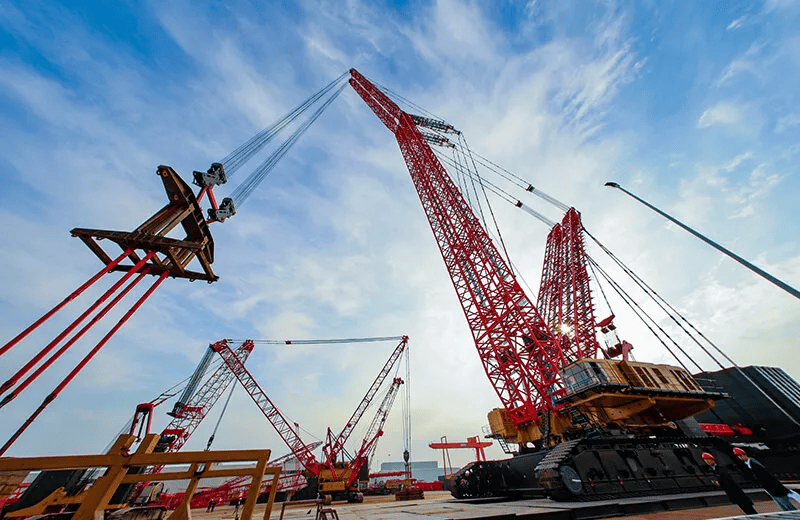
A crawler crane is a highly engineered lifting machine composed of multiple interdependent systems. From the crawler undercarriage and slewing mechanism to the boom structure and counterweight system, each component plays a vital role in performance and safety.
Understanding the components of a crawler crane helps:
- Contractors select the right equipment
- Operators work more safely
- Buyers inspect used machines more effectively
- Project managers optimize lifting operations
With proper maintenance and correct configuration, crawler cranes remain one of the most powerful and reliable heavy lifting solutions in modern construction.
If you’re considering purchasing or renting a crawler crane, understanding its structural components is the first step toward making an informed decision.
FAQ
A crawler crane is mainly used for lifting and moving heavy materials in construction, bridge building, wind power installation, and industrial projects.
Tracks help distribute the crane’s weight over a large surface area, allowing it to operate on soft or uneven ground.
The main lifting structure of a crawler crane is the lattice boom system, which provides high strength and stability during heavy lifting.
Counterweights balance the load being lifted and help prevent the crane from tipping over.
Yes, crawler cranes can rotate 360 degrees through the slewing mechanism, allowing operators to position loads accurately.